With President Trump in the White House, everything seems under assault. Civil rights, the rule of law, our moral standing, the global liberal democratic order the United States spent decades, blood and treasure helping to form and maintain. It’s all so precarious, unsettled and unprecedented. But is it, really?
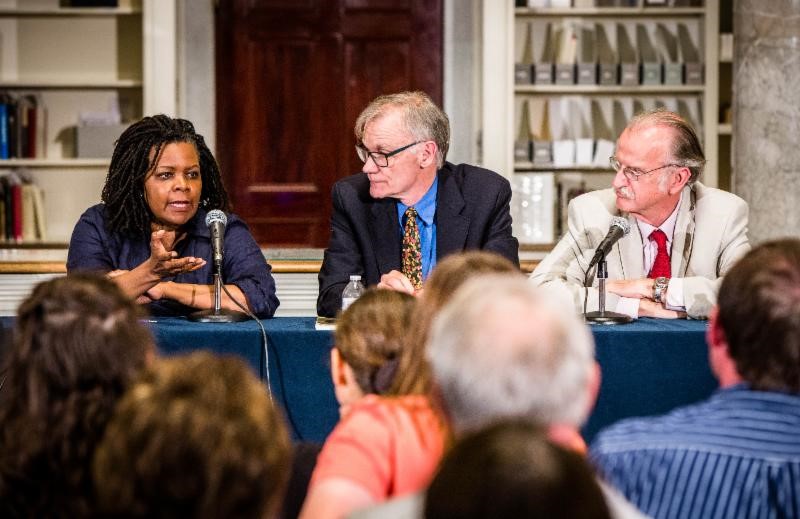
During the pilgrimage with the Faith & Politics Institute last weekend to western New York state and the landmarks of the abolition and women’s suffrage movements that were centered there, we were reminded that these dark days are neither new nor insurmountable. The scene was a panel I moderated with Rep. Tom Reed (R-N.Y.), Rep. Carolyn B. Maloney (D-N.Y.) and two history professors.
Read MoreIn Kevin Powers’ haunting second novel, “A Shout in the Ruins,” the Civil War and the destruction of slavery are a slow, multigenerational earthquake. The book sizzles with authentic tragedy, realism and unreconciled memory. There is no place for glory in this novel, which reveals black and white Southerners along the Virginia-North Carolina border region in two distinct time periods (the 1860s and 1950s-80s) living as though the past is never over.
Read MoreHistorians Peter Onuf, David Blight and Annette Gordon-Reed discussed defining equality and the Declaration of Independence.
View video: https://www.c-span.org/video/?446262-2/declaration-independence-defining-equality
Read MoreThe Root, May 28, 2018, video interview with David Blight about the origins of Memorial Day.
View video: https://www.theroot.com/black-people-created-memorial-day-literally-1826334056
Read MoreDavid Blight received an award for his commitment to ensuring excellence and equity in graduate education at the Annual Yale Bouchet Conference on Diversity and Graduate Education at Yale University on Saturday, April 28, 2018.
Read MoreFor a century and a half Ulysses S. Grant has been a baffling and inspiring presence in the American literary and historical imaginations. Born in 1822 and raised by a pious Methodist mother, as a young man he was quiet, given to depressions, and lacking much ambition. Only his love of horses seemed to animate him and give him a reason to excel in his education at West Point, which his scheming father desired for him more than he did. In his thirties, he was a complete failure, at times a drunkard, destined to die forgotten. He found his vocation and success on America’s killing fields; his meteoric trajectory in the Civil War makes him a remarkable case of a nobody who became almost everything.
Read MoreThe Gilder Lehrman Center for the Study of Slavery, Resistance, and Abolition celebrated the 20th anniversary of its founding last Friday with a panel discussion on the life of Frederick Douglass, whose 200th birthday was also last week.
Read MoreTwo hundred years ago, one of the most important Americans was born close to the Tuckahoe River on the Eastern Shore of Maryland. Frederick Bailey didn’t know the exact date of his birth, so he chose Feb. 14. Twenty years later, when he escaped from slavery, he became Frederick Douglass. By the time of his death in 1895, he had become one of the greatest orators and writers of the century.
Read MoreDavid Blight and Thavolia Glymph explored the meaning of freedom, equality and emancipation with moderator Michael Gerhardt, as part of the National Constitution Center's celebration of the 150th anniversary of the 14th Amendment to the Constitution.
View video: https://constitutioncenter.org/debate/past-programs/freedom-equality-and-emancipation
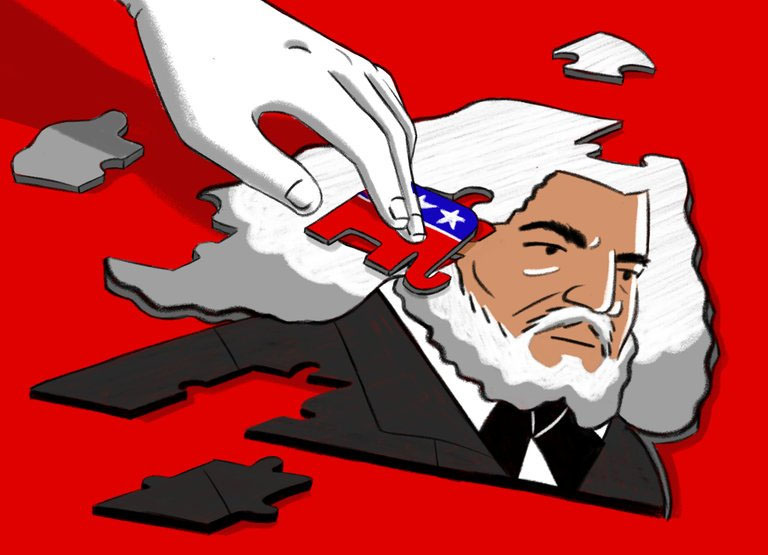
Read MoreImpeaching an unfit president has consequences. But leaving one in office could be worse.
In recent months, I have grown obsessed with a seemingly simple question: Does the American political system have a remedy if we elect the wrong person to be president? There are clear answers if we elect a criminal, or if the president falls into a coma. But what if we just make a hiring mistake, as companies do all the time? What if we elect someone who proves himself or herself unfit for office — impulsive, conspiratorial, undisciplined, destructive, cruel?
Read More“Radio West” Utah Public Radio podcast with David Blight about the history versus the memory of the Civil War.
Listen to audio: http://radiowest.kuer.org/post/remembering-civil-war?
Read MoreWhite House Chief of Staff John F. Kelly was the guest for the premiere of Laura Ingraham’s new show on Fox News Channel on Monday night. During the interview, he outlined a view of the history of the Civil War that historians described as “strange,” “highly provocative,” “dangerous” and “kind of depressing.”
Read MoreTwo months after President Trump stirred fierce debate with a defense of Confederate monuments, his chief of staff, John F. Kelly, has waded back into the fray of Civil War history.
Read More“Where We Live” podcast with David Blight, Michael Harriot, Lecia Brooks, and Fabian Wichmann
Listen to audio: http://wnpr.org/post/confronting-hate-tolerance-intolerance-and-rise-white-nationalism
Read More(CNN) Maine Gov. Paul LePage defended monuments to the Confederacy in a radio interview on Tuesday, claiming that 7,600 Mainers fought for the South and that the war was initially about land, not slavery.
Two Civil War historians contacted by told CNN disputed LePage's assertions.
Read MoreAs universities and municipalities rush to remove Confederate monuments, many historians have been stunned. For decades, they say, it was difficult to even broach the idea that the monuments were symbols of white supremacy. Public sentiment, they said, would not allow it.
“I never thought I’d live to see these monuments coming down,” said David Blight, a Yale University historian of the Civil War and Reconstruction.
Read MoreThe years leading up to 1861 saw polarised politics, paranoia and conspiracy theories. Sound familiar? David Blight reflects on America’s Disunion – then and now
“I tremble for my country when I reflect that God is just,” Thomas Jefferson wrote in 1781. The American revolution still raged, many of his own slaves had escaped, his beloved Virginia teetered on social and political chaos. Jefferson, who had crafted the Declaration of Independence for this fledgling nation at war with the world’s strongest empire, felt deeply worried about whether his new country could survive with slavery, much less the war against Britain. Slavery was a system, said Jefferson, “daily exercised in tyranny,” with slaveholders practicing “unremitting despotism”, and the slaves a “degrading submission”.
Read MoreA day after the brawling and racist brutality and deaths in Virginia, Governor Terry McAuliffe asked, “How did we get to this place?” The more relevant question after Charlottesville—and other deadly episodes in Ferguson, Charleston, Dallas, St. Paul, Baltimore, Baton Rouge, and Alexandria—is where the United States is headed. How fragile is the Union, our republic, and a country that has long been considered the world’s most stable democracy?
Read MoreThe reason the South fought the American Civil War has been contested ever since the Confederacy surrendered in 1865. An odd turn of events, considering that when 11 Southern states seceded from the Union at the war’s outset, they were very clear about why they were doing it.
Read MoreOn June 21, 2017, Gilder Lehrman Center Director David Blight and GLC summer intern Ry Walker (YC 2020) addressed a group of elementary, middle, and high school teachers at a New Haven monument to the 29th Regiment, Connecticut Volunteer Infantry. The teachers were participants in a seminar taught by Prof. Blight called “The Life and Writings of Frederick Douglass.” The seminar was organized by the Gilder Lehrman Institute of American History. Ms. Walker is a rising sophomore at Yale University. Through the Afro-American Cultural Center’s History Keepers Program, she was interning with the GLC for the month of June.
Read More